

Services > Ultratrace Persistent Organic Pollutants
PCBS & Aroclors
Analysis of Polychlorinated Biphenyls & Aroclors
Perhaps the most widely known of organic contaminants, Polychlorinated Biphenyls (PCBs) are a serious environmental issue due to their wide dispersal, persistence in the environment and multiple health effects including carcinogenicity and neurotoxicity. They are banned under the Stockholm POPs convention.
The largest source of PCBs in the environment was from their use as heat transfer fluids and dielectrics in electrical and electronic equipment including transformers. They were primarily manufactured as Aroclors, or complex mixtures of multiple PCB congeners. Aroclors vary in their composition and are designated by a 4-digit code that indicates the product series and percentage of chlorine by mass. For example, Aroclor 1242 contains 42% chlorine. There are 209 possible congeners of PCBs depending on the number and placement of chlorines. Of these, 12 PCB congeners exhibit dioxin-like toxicity. However, multiple PCBs beyond this list of 12 are toxic with other mechanisms. Non-aroclor PCBs including PCB-11 from paint and pigment manufacture and use are also becoming prominent in the environment.

PCB Testing needs
As a highly regulated contaminant, accredited PCB measurement is required in multiple cases
- Compliance monitoring in drinking water, waste for NPDES, stack emissions, soil disposal, building materials and more
- Contaminated sites monitoring and remediation, especially in sites next to historic industrial activity, Superfund sites and more
- Brownfields and offshore redevelopment. Any redevelopment of a site at or adjacent to historic contamination can result in a new PCB issue due to exposure of the sediments making them bioavailable. PCB monitoring can hence be a major requirement for offshore wind development, brownfields redevelopment and more
- Food and feed testing
- Ongoing ambient testing in natural resource damage assessments and total maximum daily load (TMDL) including fish tissue measurement

Application Spotlight
PCBs in Tree Swallows for the Great Lakes Restoration Initiative
SGS has supported the United States Geological Survey in their Great Lakes contaminant monitoring studies. Custer et al. 2018 published results in tree swallows based on multiple years of PCB monitoring. Tree swallows were used as they feed close to their nests, and so, their eggs and nestlings are sensitive indicators of contaminant exposure by location. Our sensitive, accurate and precise 1668C GC-HRMS method allowed for measurement by site with as low as 5 eggs/nestlings per site. Results showed that PCB levels at these locations are stable year-to-year.
Reference
Custer, C.M., Custer, T.W., Dummer, P.M., Goldberg, D., and Franson, J.C. (2018). Annual variation in polychlorinated biphenyl (PCB) exposure in tree swallow (Tachycineta bicolor) eggs and nestlings at Great Lakes Restoration Initiative (GLRI) study sites. Environ Monit Assess 190, 227.
Contact SGSPCB measurement and SGS
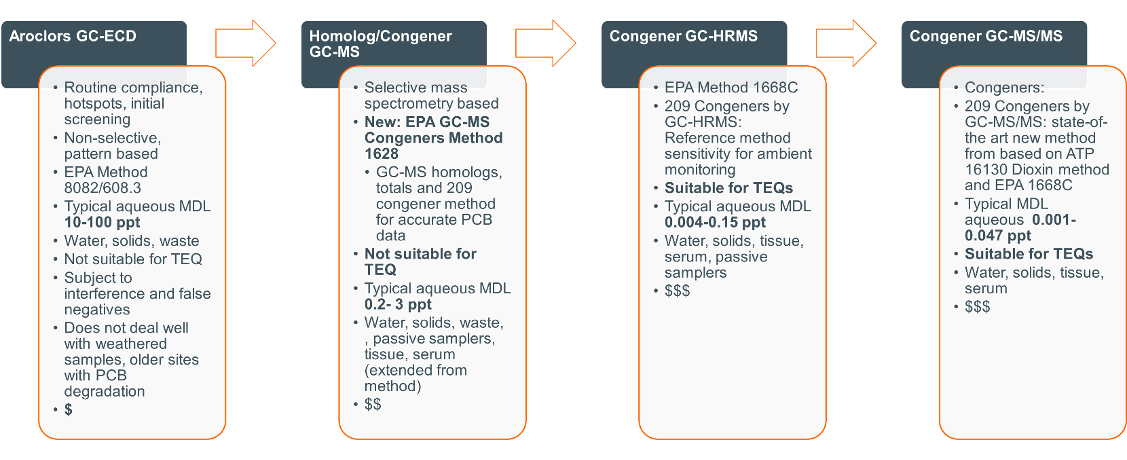
PCB monitoring is a complex landscape with many options, and SGS provides analytical support for all PCB testing needs. Use our tools below to pick your approach of choice depending on what you need.
Why SGS for Ultratrace Analysis?
- POPs and emerging contaminant expertise: Passive and active sampling projects require experienced analysts and scientists with particular sampling experience.
- Support for samplers including cleaning, loading and more
- Customized Analytical Plans: Tailored testing protocols to address unique project challenges including custom performance reference compounds (PRCs)
Our Offering
|
Method |
Attributes |
Matrices |
|
Reference GC-ECD solid waste method |
Aqueous, solids, waste |
|
|
Reference GC-ECD office of water method for NPDES |
Aqueous |
|
|
GC-ECD method for indoor air |
Air filter/sorbent |
|
|
New GC-MS congener and homolog method for PCB compliance testing and other applications
|
Non-potable water, soils/sediments, waste, tissue |
|
|
Reference method for low-level PCB 209 congener testing and TEQ determination. Ideal for fingerprinting and forensics |
Drinking water, Non-potable water, soils/sediments, waste, tissue |
|
|
Inhouse GC-MS/MS |
Fully equivalent to 1668C for all applications, superior sensitivity and performance |
Non-potable water, soils/sediments, waste, tissue |
|
Standard method for measurement of dioxins, PCBs and PAHs in stack stationary sources. Method 23 was extensively updated in 2023 with requirements that increased the complexity of the test. SGS was one of the first laboratories to transition successfully to the new M23 |
Stack stationary sources (Filter, XAD, impinger and rinse) |
SGS offers several advantages as your PCB testing partner
- Multiple instrument approaches at high capacity to meet every application need: GC-ECD, GC-MS, GC-HRMS and APGC-MS/MS.
- We are especially battle tested on large, complex remediation and redevelopment projects such as work in the Passaic River superfund sites where our attention to detail on complex samples, high capacity, and technical and project management expertise has meant consistent data and service quality in very challenging circumstances. Our experience and data quality provides data of unparalleled defensibility for high-importance litigation and remediation projects
- Our push towards reduced sample volumes and microextraction means the same high-quality PCB aroclor data from small sample sizes
- Methods leadership: We are the originator of the EPA-1668 method for ultratrace congener PCB analysis and fingerprinting, and EPA 1628, the GC-MS congener method to replace legacy aroclor methods for permitting.
- SGS stands alone in the industry with its ability to achieve and maintain low procedural blank and background levels for 1668 and GC-MS/MS through careful preparation of glassware and overall laboratory cleanliness.
- We measure PCBs in all environmental, biota and human matrices for a comprehensive solution for your wastewater treatment plant studies, Total Maximum Daily Loading (TMDL) studies and more.
- Coextractions and sophisticated multiplexing with dioxins, pesticides and more to generate 100s of POP measurements at low detection limits from a single, limited sample.