
 When my kid was younger, this book on sea otters – Sea Otter Pup was a hit! They are interesting and charismatic creatures.
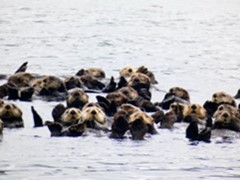
I was lucky enough to see a population just floating around in the Clayquot Sound near Ucluelet on Vancouver Island British Columbia last year (see photo). They had gone almost extinct in BC before a population from Alaska was reintroduced more than 50 years back. Now they are thriving as you can see and are a keystone species in the kelp “forest” marine ecosystem.
PFAS Levels in Sea Otters
What about PFAS levels in sea otters? We participated in a recent study featuring co-authors from the University of British Columbia, Fisheries and Oceans Canada and the SGS AXYS Sidney laboratory as well. The study measured PFAS in 11 sea otters that had been found deceased. The reference method of choice EPA 1633 was used to analyse these liver and muscle tissue samples for 40 PFAS analytes. This was the first study of PFAS in British Columbia, though there have been measurements elsewhere. Sea otters also do not travel far, so exposure measurements track local conditions well.
What Did the Study Find?
 First off, to answer my (admittedly silly) question in the title, no. Sea otters have through the wonder of evolution developed amazing dense waterproof fur that enables them to keep warm and dry in these very cold waters, no PFAS or even blubber needed.
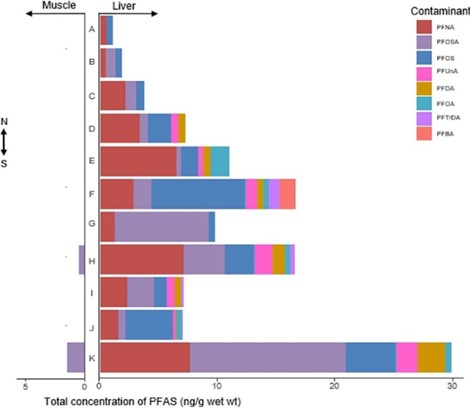
The study found eight of the PFAS in EPA 1633 detected consistently in the liver tissue, and two orders of magnitude less in the muscle, where only PFOSA was detected occasionally (Figure 1). In the liver, the three most prevalent PFAS were PFNA, PFOSA, and PFOS. These PFAS also feature in many other animal studies due to their concentration in the environment, longer half lives and chain lengths. Otters from the less urban, more Northerly areas showed much lower concentrations than those living near more urban areas, which you would expect given their diet of benthic invertebrate sea urchins is likely the biggest source of PFAS exposure. What otter K was eating I’d like to know.
Figure 1: Per-/polyfluoroalkyl substances (PFAS) found in the liver (right) and skeletal muscle (left) of 11 deceased sea otters. Each animal is identified by a letter that reflects where it was recovered in coastal British Columbia (Image from the study website
How do These Numbers Compare With Other Marine Mammals?
Given their location in the food web, you’d expect much lower concentrations of these biomagnifying PFAS than in apex predators. As expected, concentrations were 60 – > 100 times lower than in killer whales. The authors also note that these concentrations are “lower than toxic thresholds established in other mammalian species”. The authors in the discussion indicate that no correlations were found between carcass condition and PFAS, again expected given the levels measured.
Overall, we were happy to be a part of this first study on sea otters and PFAS in BC. The story of sea otters in BC is primarily a good news one, and as phaseouts of longer chain and more toxic PFAS continue, we expect these levels to drop further with time.
If you would like to read the entire study for more information, it is open source.
Questions?
Want to measure environmental contaminants in other charismatic (or not) creatures? Contact us.
References
Price, D., Trites, A.W., Raverty, S., Cottrell, P., Cottrell, B., Zysk, I., Alava, J.J., 2025. Concentrations of per- and polyfluoroalkyl substances in Canadian sea otters (Enhydra lutris) are higher near urban centers. Environmental Toxicology and Chemistry vgaf226. https://doi.org/10.1093/etojnl/vgaf226
US EPA, 2024. Method 1633A Analysis of Per- and Polyfluoroalkyl Substances (PFAS) in Aqueous, Solid, Biosolids, and Tissue Samples by LC-MS/MS.