
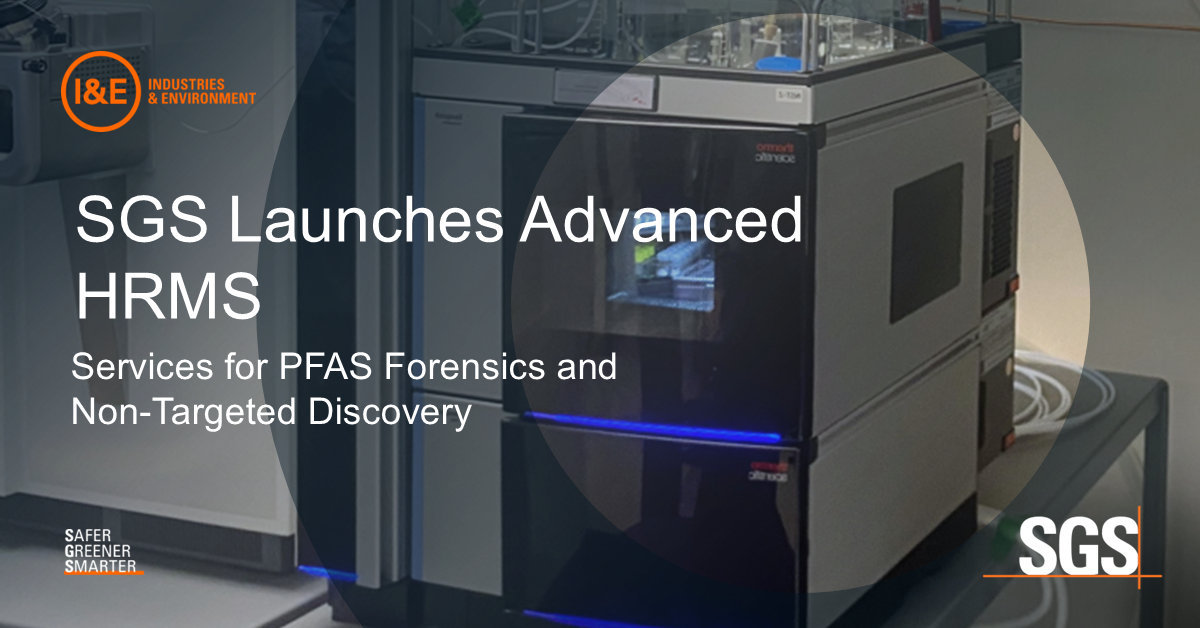
SGS North America is pleased to announce the launch of our enhanced High-Resolution Mass Spectrometry (HRMS) services, delivering industry-leading capabilities for PFAS forensics, confirmation testing, suspect screening, and non-targeted analysis (NTA). This expanded service offering provides the analytical depth needed to identify emerging PFAS, resolve questionable detects, and uncover previously uncharacterized fluorinated compounds.
As PFAS challenges continue to evolve, HRMS has become an essential tool for environmental professionals seeking a more comprehensive understanding of their samples and the sources behind them.
Why High-Resolution Mass Spectrometry Matters for PFAS
Modern HRMS instruments provide the mass accuracy and resolving power required to distinguish PFAS from interferences, remove false positives, and identify unknown peaks with confidence. This level of resolution allows analysts to:
- Identify unknown PFAS not captured in typical target lists
- Produce rich chemical fingerprints to support source identification
- Investigate questionable detects with a high level of confirmation
- Characterize precursor transformation during treatment and remediation
For organizations managing PFAS-impacted sites, HRMS offers a level of clarity and confidence that traditional unit-resolution methods cannot match.
Why SGS?
- As with all our work, the emphasis is on quality, reproducibility and standardization. We work with the Best Practices for NTA (BP4NTA) framework to ensure studies are designed and reported according to the best available standards.
- Our extensive experience with PFAS testing means access to a large repository of labeled and unlabeled reference standards with a goal of maximizing Schymanski Class 1 confidence level detections in your datasets.
When HRMS Testing Is the Right Choice
HRMS is the recommended approach when:
- You need information on more PFAS than a standard target method can capture
- You need to answer forensic questions such as source attribution or historical fingerprinting
- You need deeper insight into inputs, transformation products, remediation outputs, or look for products of incomplete destruction
- You want to maintain a rich data archive for retrospective analysis of your samples, going back and looking for unknowns in the past!
- You need to resolve uncertain or questionable detections
As PFAS chemistries expand and regulations tighten, organizations need tools that provide broader coverage and greater analytical certainty, making HRMS an essential part of a modern PFAS testing strategy.
How HRMS Fits into PFAS Forensics
HRMS strengthens every stage of PFAS forensic investigations:
Target Analysis
- Quantitative measurement of known PFAS
- Use of isotope-dilution and reference standards
- Full-scan HRMS data collected simultaneously for expanded insight
Suspect Screening
- Matches features against libraries of known PFAS
- Enables relative quantitation using available standards
- Helps build context around potential sources and pathways
Non-Targeted (Untargeted) Analysis
- Discovers previously unreported or uncharacterized PFAS
- Uses advanced workflows for feature annotation and confidence classification
- Provides qualitative identification of thousands of potential structures
Together, these layers of analysis create a high-definition view of PFAS occurrence and behavior that supports stronger environmental decisions.
High-Resolution Non-Targeted Analysis: What to Expect
SGS performs a full high-resolution run using workflows modeled on EPA 1633 preparation or direct injection/cosolvation extraction, depending on sample matrix. In addition to routine EPA 1633 workflows, all matrices except tissue and serum are supported by cosolvation methods modeled on ASTM D8421 or ASTM D8535. .
Our HRMS workflows include:
- Level 1 identification: 90+ PFAS confirmed with reference standards
- Level 2 identification: >900 PFAS matched via multiple spectral libraries
- Level 3 annotation: ~50,000 structures available for suspect screening
- Level 4–5 information: Provided as raw data for advanced client research
Each feature undergoes rigorous expert review to ensure accuracy, consistency, and defensible reporting.
High-Resolution Confirmation for PFAS
High-resolution confirmation offers unparalleled confidence:
- HRMS instruments provide the mass accuracy needed to unequivocally identify PFAS
- Improved sensitivity and accessibility make HRMS increasingly practical for commercial environmental testing
- High resolution allows analysts to distinguish compounds that would otherwise overlap at unit resolution
This eliminates ambiguity, strengthens data defensibility, and supports regulatory and remediation decisions with precision.
A New Era of PFAS Insight
With the introduction of our enhanced HRMS services, SGS now offers a complete solution for:
- PFAS forensics
- Non-targeted discovery
- Suspect screening
- High-resolution confirmation
- Source identification and fingerprinting
- Transformation and treatment studies
Environmental professionals gain access to a richer, more complete picture of fluorinated chemistry, empowering stronger decision-making and long-term site management.