
How do you know how stable emerging contaminants are in samples?
This is a surprisingly challenging question as stability and storage data on emerging contaminants is hard to come by while being crucial to our understanding of their occurrence, fate and transport. Our expert SGS Senior Scientist Dr. Coreen Hamilton contributed to the research article Degradation of bisphenols, halogenated flame retardants, and pesticides in wastewater and biosolids samples during frozen storage.
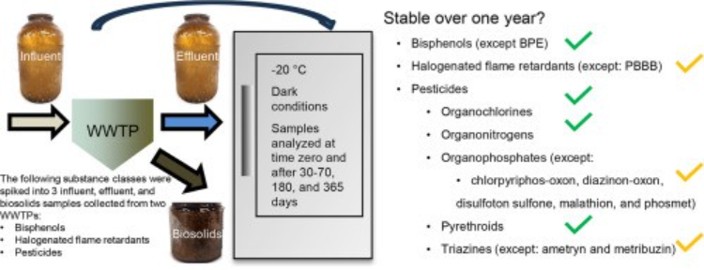
This publication provides insights into wastewater and biosolids as important pathways of chemicals to the environment and thus are often included in monitoring programs. This study evaluates the stability of bisphenols, halogenated flame retardants (HFRs), and pesticides in frozen (−20 °C) wastewater media over a one-year period. It’s a unique showcase of SGS’ extensive and unique capabilities with emerging contaminant measurement. The study included 6 different bisphenols, 25 halogenated flame retardants (other than polybrominated diphenyl ethers or PBDEs) and 76 pesticides from EPA 1699.
The findings indicate that wastewater and biosolids samples can be stored frozen, and concentrations of bisphenols, HFRs, and pesticides are not affected by chemical transformation, with a few exceptions.
Read the full paper to learn more about this insightful research and its findings here Degradation of bisphenols, halogenated flame retardants, and pesticides in wastewater and biosolids samples during frozen storage – ScienceDirect