
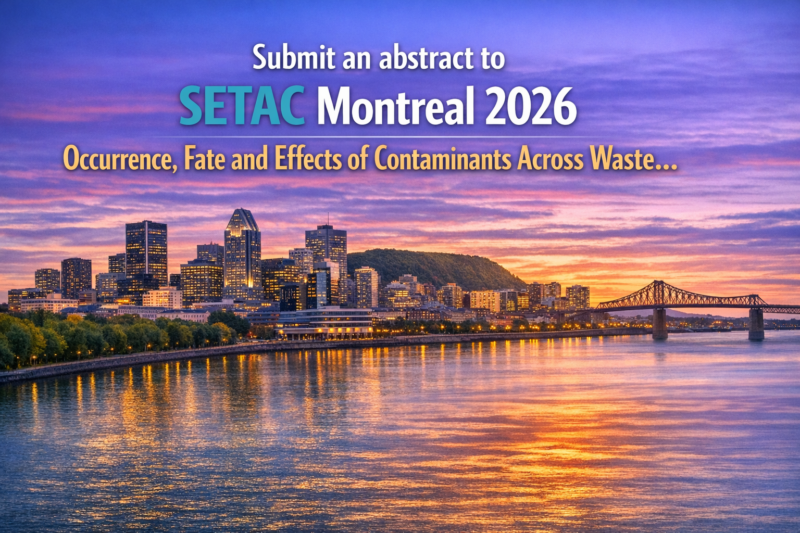
We invite people planning or considering attending the 47th Annual SETAC North America Conference in beautiful Montreal to send in an abstract to our session on the occurrence, fate and effects of contaminants across waste and wastewater systems. This session has been running for a number of years through the North America Chemistry Interest Group and brings together diverse research on many kinds of contaminants entering the environment through our waste processing systems. From PFAS in landfills, microplastics in biosolids to heavy metal contamination in effluents, there’s so much interesting discussion!
Abstract deadline is June 3rd at 1700 Eastern.
To find our session, click on “submit your abstract” from the homepage, write-up your abstract, and when it comes to session selection, click on “4. Chemistry and Exposure Assessment” to find our session starting with Occurrence, Fate (the list is alphabetized). That’s it. The abstract is below, and please reach out if you have any questions. We look forward to seeing you in Montreal!
Session: Occurrence, Fate and Effects of Contaminants Across Waste and Wastewater Systems
Track: 4. Chemistry and Exposure Assessment
Bharat Chandramouli (SGS)
Sarah Gewurtz (Environment and Climate Change Canada)
Eric Nelson (LA County Sanitation District)
Ochan Otim ( City of Los Angeles)
Session Abstract
Storage and treatment systems for domestic (on-site, municipal wastewater and landfills), agricultural (waste and runoff) and industrial wastes (i.e., produced water from hydraulic fracturing operations) represent major potential sources and vectors of chemicals to the environment. These wastes are complex mixtures of nutrients, salts, metals, microbes and organic chemicals, including contaminants of emerging concern (CECs) such as microplastics, pharmaceuticals, illicit drugs, personal care products, per- and poly-fluoroalkyl substances (PFAS), flame retardants, plasticizers, solvents naturally occurring radioactive materials (NORM), oil derivatives, glycol polymers, ethoxylated alcohols, quaternary ammonium compounds and many others yet to be fully characterized. These chemicals may pose risks to human and ecological health, and some can also serve as tracers for tracking waste sources, co-contaminant transport and environmental fate. In addition, studying the partitioning of substances between the liquid and solid waste streams, as well as their transformation, can provide insight into environmentally relevant physicochemical properties and fate. Waste and waste-impacted environments are challenging to study due to the enormous diversity of chemicals, complex sample matrices which create analytical difficulties and influence of transport and fate mechanisms. This session will aim to highlight advancements in analytical, experimental and modeling approaches that improve our understanding of chemicals (particularly CECs) in domestic, agricultural and industrial waste. Research topics covered in this session include the occurrence and fate of these chemicals, their use as tracers to probe fate, transport and physicochemical properties, the characterization of effects on biota in the receiving environments and emerging treatment methodologies. We invite research covering the broad range of sources and pathways including municipal wastewater treatment systems, landfills, agricultural sources and runoff and industrial sources such as produced water, as well as less conspicuous releases including on-site septic systems, wastewater lagoons, leaking sewers, historic landfills and the land application of sludge and biosolids.